
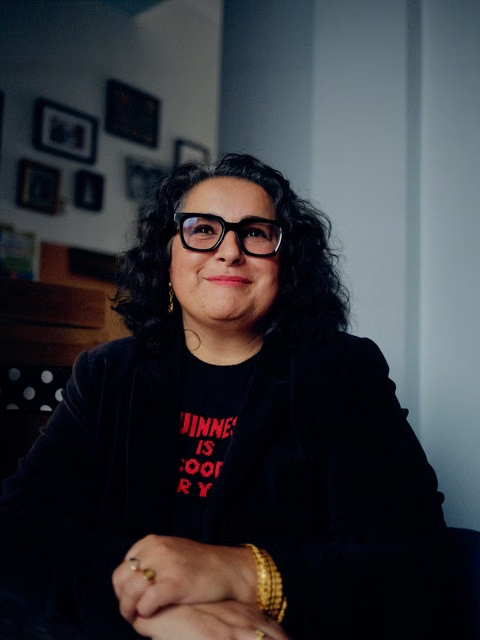
Filmwire Spotlight: Shaheen Baig
Name a British independent film from the past twenty-five years, and it’s very likely that Shaheen Baig cast it.
From Locke to God’s Own Country to Blue Jean, Birmingham native Shaheen has made an impressive mark on the world of British independent film, finding incredible talents and pairing them up with cutting edge directors. And she’s done it again with I See Buildings Fall Like Lightning, the new Birmingham-set film from Clio Barnard which features a who’s who of young British talent, including Jay Lycurgo, Lola Petticrew and Daryl McCormack. We talked to Shaheen ahead of the film’s release, discussing Midlands representation on screen and her work with the cream of indie cinema.
How did you come to be involved with I See Buildings Fall Like Lightning?
Clio and producer Tracy O'Riordan sent me the script and asked me to read it. I was aware of Kieran [Goddard]'s book, because it's about Birmingham and I’m from Birmingham. We had a conversation and it was actually a fairly quick turnaround. It was one of those golden opportunities whereby, if we could pull the cast together, we could make it fairly quickly. Normally when you're sent a script, there's a period of time after you read it, then you go into development, then you go into pre-production. That usually takes a long time, whereas this was relatively quick.
As a Birmingham native, was it exciting to work on a project both set and filmed in the city?
I love working on projects that are set where I'm from, it's really important to me. This project ticked all the boxes. A great writer, a great script, an amazing creative team. It heavily features the Birmingham Irish community and I knew that I would get to come home and do some casting. So, for me, it's a dream job really!
Did you have an open call to cast the film?
It was really important for me and Clio to include the community as much as we possibly could. And I think when you're making a film, you're telling a story about community, so I think it's really key to include them. We did a huge amount of flyering, talking to people, engaging the public, and it all accumulated into a massive open call, where around 800 people turned up. We cast a lot of people from that open call - all the supporting cast, all the people in the pubs.
What do you say to those who criticise a film like I See Buildings, where the lead cast isn’t from the region?
But that's how any film or television gets made. You look at anything that comes out, and people comment and go, ‘Why is it that person in it? They're not from that region’. But you’re trying to get a film financed, or a piece of television commissioned, and ultimately you want people to see it. So it's really important to put actors in that who are going to be - in some way - a draw for the audience, alongside the filmmaker and the subject matter. Listen, I've been doing Peaky Blinders for years. I've heard that argument many times, but it’s about getting the film made. I want to see stories set in my hometown. That to me is the most important thing. I get it, but people that make those criticisms don't understand how the industry works. And it's sort of a naive thing to say because the reality is that if it was always cast that way, then most of the things we see wouldn't ever get made.
Did the cast get to do a lot of work together before filming started?
They did do rehearsals. We weren't able to do chemistry reads or anything, because the actors were all over the world working. If you can do that, it's an absolute luxury, but it rarely happens. It was about looking for the sensibility of people, looking at the style of acting, looking at who you actually believed would be a group of friends. Do I believe that these people grew up together? Do I believe that their lives are entwined? Do I believe that they all love each other? And obviously, the Irishness of the project is really, really important. The other thing that I know I talked a lot to Clio and Tracy about was - who do I believe could be from Birmingham? It’s not just about the accent, it's about a sensibility. And we've all watched things where we go, ‘I just don't believe they're from that place’. They don't even have to open their mouth. It's just a vibe, isn't it? And so, for me, I wanted to cast this group of friends that I believed would come from the place down the road from me.
Where did you grow up in Birmingham?
I grew up in Gravelly Hill, just by Spaghetti Junction in Erdington. I feel really lucky to have grown up in Birmingham, because I'm a mixed-race girl, I come from a very working-class family and grew up in a really richly diverse community. That’s one of the greatest things Birmingham has given me. I think that is absolutely one of Birmingham’s strengths and power, that it's properly representative.
Do you feel like you want to represent your home city more at this stage in your career?
Film is about many different things. It's about escapism, it's about joy, but it's also about telling the truth as much as you can, or rather telling the stories about people who are never going to tell their own story. And I increasingly want to contribute to stories that I feel some connection to, so I actively choose to do some projects that I feel representative of my class or culture or heritage. England is a hugely diverse country and the power is in the regions, but we rarely tell those stories. I think anything that contributes to that, I want to be a part of it.
Do you also feel a duty to represent working class communities, who aren’t seen that often on screen?
I think when people put a lens on working-class communities they can focus on misery and struggle. I worked on a film a couple of years ago called Scrapper that Charlotte Regan directed. And what I really love about what Charlotte did with that film is…yes, this is an estate, but it's full of joy. People's houses are beautiful and clean and tidy. People are actually having a good time. This community is tight. I think you very rarely see that on screen. Yes, life is hard for lots and lots of people, but it's not joyless. Anything that filmmakers can do to change that narrative can only be a good thing, because it's a really lame stereotype.
Do you feel there’s more film and TV production happening in Birmingham now that Digbeth Loc. studios have opened?
I think Steven Knight is on a crusade. He's got his studios up and running now. We just shot the new Peaky series there and we shot the film there. More and more films are being shot in the West Midlands, whether it's Coventry or Birmingham, and I think it will continue to happen. We should have the same infrastructure that they have in Manchester or Leeds. A lot of these cities have got studios. I really admire what Steve’s trying to do. It’s madness that we've not had a studio in Birmingham for so long.
Can you tell us about working with East Midlands legend Shane Meadows on his new film Chork?
I can't really say a lot about that film, but I've worked with Shane a few times. I love working with him and that film will be out next year. It was a joyful experience. I've worked a lot in the East Midlands. I've worked with Warp Films a fair amount who are obviously based in Sheffield, but a lot of their stuff ends up being filmed in the East Midlands. I'm trying to represent all of the Midlands, essentially (laughs).
So why do you think all these great independent filmmakers - Shane [Meadows], Clio (Barnard], Carol Morley, Ben Wheatley, Peter Strickland - continue to work with you?
Oh, I don't know. I can't answer that question! Look, in this industry, I think you're as good as your last job, really. And I feel very strongly that a filmmaker approaches me because they've seen something I've done and they like it. And maybe they like the way I interpret a story. And I think that's it, really. I want my work to be my calling card, and if somebody likes that way that I contribute to stories, then brilliant. And so that's how I see it with the filmmakers I work with, and some I've worked with repeatedly and some I haven't. I’ve worked with Shane several times, I've worked with Clio several times, but each time is completely different. Every experience is uniquely different to the one before. I never take anything for granted.
I See Buildings Fall Like Lightning screens at the Midlands Arts Centre on Tuesday 1st Dec with Clio Barnard and author Keiran Goddard in attendance and is on nationwide release from Friday 4th Dec.
This interview featured in the November edition of Filmwire. Sign up to the Filmwire newsletter to stay in the loop on all the latest Midlands film happenings.